

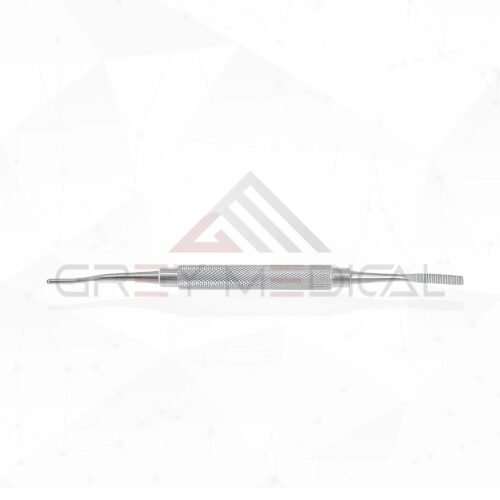
A rasp bone tool serves a vital function whenever surgeons must shave, smooth, or reshape osseous tissue without causing unnecessary thermal trauma or rough fractures. Unlike heavy saws or coarse chisels that remove bulk material aggressively, a fine-toothed file glides across bone ridges to refine contours prior to implant placement or wound closure. In rasp bone orthopedic, podiatric, maxillofacial, and plastic surgeries, controlling surface smoothness directly influences soft-tissue healing and joint mechanics. Surgeons rely on tactile feedback through the handle to judge tissue density and adjust filing pressure with steady precision.
Design Features and Serration Patterns for Controlled Filing
Effective bone filing depends on tooth geometry, blade profile, and ergonomic balance that prevents hand fatigue during long operations. Most surgical rasps feature milled or cut serrations arranged in straight, curved, or cross-cut patterns that clear bone dust cleanly rather than clogging under pressure. Slim or angled shafts allow clinicians to reach deep cavities, nasal dorsum bridges, or small joints where straight instruments lose line of sight. Balanced handles provide confident grip control whether the surgeon works with light pulling strokes or firm downward passes.
Clinical Applications Across Orthopedics, Podiatry, and Rhinoplasty
Clinicians adapt a rasp bone file to match the anatomical delicacy and structural demands of each surgical specialty. In dorsal preservation and structural rhinoplasty, fine rasps gently lower bony humps while preserving nasal airway integrity and overlying skin smoothness. Foot and ankle specialists use compact rasps to smooth bunion resections, exostoses, and phalangeal edges so footwear does not irritate sensitive areas. Orthopedic and hand surgeons similarly rely on rasps to level bone grafts, prepare cortical surfaces, and create clean margins around osteotomies.
Metallurgy, Corrosion Resistance, and Sterilization Longevity
High-grade medical stainless steel gives a rasp bone instrument the edge retention and rigidity needed to withstand repeated contact with dense mineralized tissue. Precision heat treatment keeps cutting teeth sharp across numerous procedures while resisting bending or micro-chipping under normal surgical loads. Smooth surface finishes and well-formed joints simplify enzymatic cleaning, ultrasonic washing, and steam autoclave cycles without trapping bioburden in crevices. Consistent care and proper instrument trays protect delicate serrations from colliding with heavier tools during reprocessing.
Choosing the Right Pattern for Surgical Efficiency and Safety
Selecting the proper rasp bone configuration starts with matching blade length, tip curvature, and tooth coarseness to the target anatomy and approach. Fine teeth suit delicate facial or digital bones where subtle adjustments matter most, while slightly coarser teeth scissors to remove stitches minor irregularities faster on sturdier bone segments. Clear visibility, unobstructed access, and steady stroke control protect nearby nerves, tendons, and periosteum from accidental abrasion. Hospitals and clinics gain smoother workflows when instrument sets group complementary sizes and profiles logically for each procedure type.
Grey Medical Standards and Clinical Reliability
Grey Medical supports surgical teams with precision-crafted instruments engineered for dependable performance across demanding operating room environments. Careful attention to metallurgy, dimensional accuracy, and finishing helps clinicians execute smooth, controlled bone contouring from incision to closure. Pairing reliable instrumentation with sound surgical technique supports predictable anatomical outcomes and long service life in busy facilities.
Conclusion on Precision Bone Contouring
Mastering bone surface refinement requires instruments that balance sharp cutting efficiency with gentle tissue handling and dependable durability. A well-made rasp bone instrument enables surgeons to achieve smooth margins, accurate fits, and clean anatomical transitions across diverse specialties. With thoughtful selection, proper sterilization care, and trusted craftsmanship from Grey Medical, surgical teams can approach delicate bone contouring with confidence and precision.

 English
 Arabic
 French
 Spanish
 Portuguese
 Deutsch
 Turkish
 Dutch
 Russian
 Romaian
 Portuguese (Brazil)
 Greek